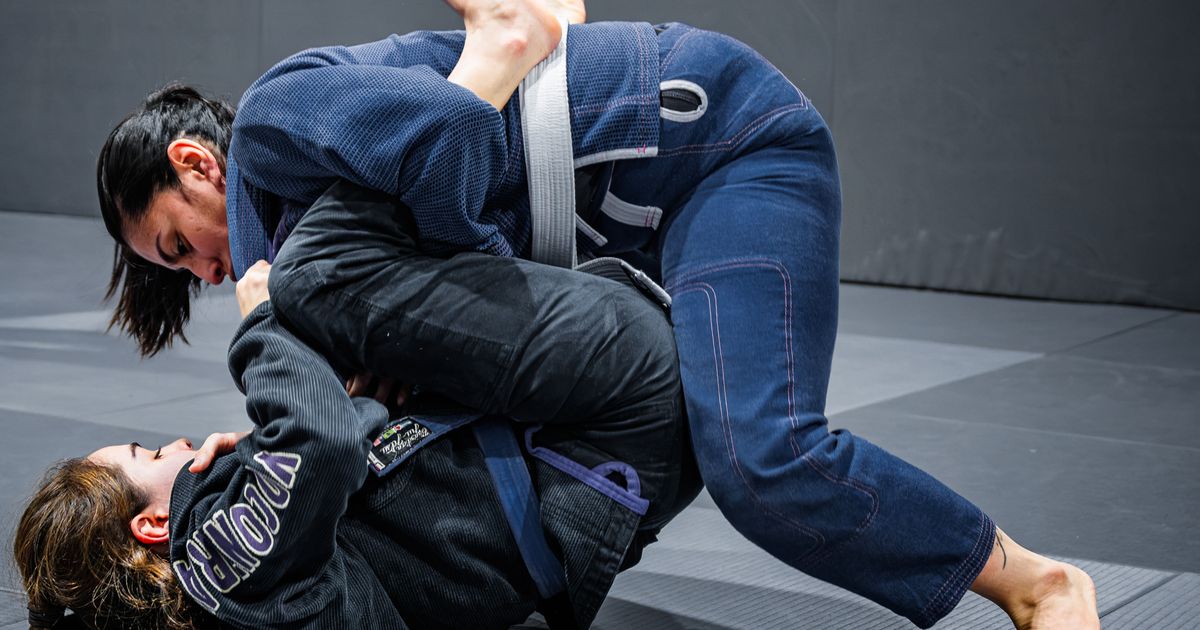
Most nights on the mats, we’re the smallest person in the room. That’s just the reality of BJJ for smaller women: you walk into a class where almost everyone outweighs you by 30, 50, sometimes 80 pounds, and you’re expected to figure it out. After more than a decade of training and a black belt earned rolling with people twice our size, we can tell you it’s not only survivable, it’s where jiu-jitsu actually gets interesting. This guide covers what genuinely works for small frames, what wastes your energy, and how to protect your body while you learn.
The honest part first: size does matter
You’ll hear “jiu-jitsu was made for the smaller person” in every academy lobby in the world, and there’s truth in it, since the art was famously built around leverage. What that slogan skips is the fine print. Between two people of equal skill, the bigger one usually wins, which is exactly why competitions have weight classes. So let’s set a realistic goal: technique won’t erase a 60-pound gap against an experienced opponent, but it absolutely closes the gap against untrained strength, and it beats bigger training partners who are a belt or two behind you in understanding. That happens every single night in academies everywhere, and it can be you doing it.
Why the guard is your home base
When someone heavy is on top of you in side control, their weight works against you every second. Flip that scenario: when you’re playing guard, your legs, the strongest levers you own, are between you and their weight. This is why almost every successful small grappler builds their game around the guard.
Closed guard is the first priority. Learn to break posture and keep it broken, because a bigger opponent who can’t posture up can’t use their weight. From there, attacks that rely on your whole body against one of their limbs, like the armbar and the triangle, are your bread and butter. A triangle choke doesn’t care how much your opponent benches. Their carotid arteries are the same size as everyone else’s.
As you progress, open guards that manage distance become gold for smaller bodies. Spider guard and lasso in the gi let you control a bigger person’s arms with your legs, and De La Riva gives you angles instead of collisions. The theme across all of them: your legs versus their arms is a fight you can win. Your arms versus their arms is not.
Positions that favor a small frame
Back control is the great equalizer, full stop. From the back, their strength has nowhere to push, they can’t see you, and your size becomes an advantage because you’re harder to peel off. Small, mobile grapplers often take the back in scrambles where a heavier person simply can’t move that fast. If you invest deeply in one dominant position, make it this one.
Knee on belly and technical mount also reward lighter athletes more than people expect, since both rely on precise weight placement rather than total mass. And in transitions, speed is a weapon the big guys don’t have. The half-second where a 200-pound training partner is mid-turn is your window, and you’ll learn to feel it.
The three traps that drain smaller grapplers
The first trap is bench-pressing people off you. Pushing a heavier opponent away with straight arms from the bottom burns your shoulders, feeds them your elbows for attacks, and never actually works. Frames are different: a frame is your bone structure placed against their collarbone or hip so their weight is held by your skeleton, not your muscles. Learn the difference early and drill it forever, because escapes built on frames, bridges and hip movement will still work when you’re exhausted, and escapes built on pushing won’t.
The second trap is matching strength in grip fights. If you grip fight a stronger person symmetrically, wrist against wrist, you lose. Grip smarter instead: two hands on one sleeve, break their grip before you build yours, and target the last two fingers where every grip is weakest. A good gi that fits properly matters here too, since sleeves that are too long give your partner free handles. Our women’s gi sizing guide covers how a proper fit removes those free grips, and if you’re still shopping, start with our guide to the best BJJ gis for women.
The third trap is refusing to concede position. Sometimes holding a losing position against big pressure costs you more than giving it up and recovering guard. Experienced small grapplers give ground constantly, on purpose, and reset to positions where their game works. That’s not losing. In the long run it’s how you stop getting hurt.
Energy is a technique
A bigger opponent can afford to waste effort and still have plenty left. You can’t, so pace becomes part of your game. Explode only in the moments that decide something, like a scramble for the back or the second half of a sweep, and stay relaxed the rest of the round. Breathing through your nose during positional work sounds like a small detail until you try it and realize how much longer your rounds last. Watch the best lightweight competitors and you’ll notice they look almost calm until, suddenly, they don’t.
Rolling with much bigger partners without getting hurt
This part matters more than any sweep we could teach you. You get to choose who you roll with. A controlled, experienced big partner is often safer than a spazzy white belt who weighs 40 pounds less, because control is what causes or prevents injuries, not weight alone. If someone smashes with full force every round, you’re allowed to decline the roll, and any academy that punishes you for that isn’t an academy worth your monthly fee.
Two habits protect your body. Tap early against big partners, especially on pressure and stacking positions, because bravery against 220 pounds is how ribs and knees get hurt. And talk before the roll: a simple “let’s flow, I want to work my guard” sets the pace with most decent training partners. If you’re brand new and this all sounds intimidating, our guide on what to expect in your first BJJ class walks through those first weeks in detail.
Proof it works: watch the small women at the top
None of this is theory. Watch footage of the lightest divisions in world championships and you’ll see rooster and light-feather athletes with some of the most technical, creative jiu-jitsu on the planet, precisely because they never had the option of muscling through anything. Many of the sport’s most respected competitors built their entire legacy at featherweight and below. We profiled several of them in our roundup of famous female BJJ black belts, and if you need a role model for a small-person game, that list is full of them.
A game plan you can steal tonight
If you want something concrete to run in your next training session, here’s a simple flow we’ve taught to dozens of smaller students over the years. On the feet, don’t stand and trade grips with someone stronger, pull guard on your terms before they settle theirs. Once you’re in closed guard, your only job for the first thirty seconds is posture: collar grip, break them down, climb your legs high on their back and keep their head below their hips in spirit if not in geometry.
From that broken posture, hunt in pairs. Attack the armbar, and when they pull the arm out, their elbow crossing your centerline hands you the triangle. When they posture hard to escape the triangle, that’s the moment your hip bump or scissor sweep suddenly works, because their weight is moving backward and you’re borrowing it. Nothing in that sequence asks you to be strong. Every step borrows their reaction, which is the entire point of playing a small game: you’re not creating force, you’re redirecting theirs.
Run that loop for a month of open mats and you’ll feel the difference against bigger partners before anyone tells you it’s visible.
Where to start this week
Pick one thing from this article and drill it for a month. If you’re brand new, make it frames and hip escapes. If you already have some mat time, make it closed guard posture control or grip breaking. Small games are built in layers, and the women who beat bigger opponents at your academy all started with the same layer you’re standing on now.
FAQ: BJJ for smaller women
Can a smaller woman really beat a bigger man in BJJ?
Against an untrained person, yes, routinely, and it’s one of the most documented phenomena in grappling. Against a trained opponent, the skill gap decides it: a smaller woman with significantly more experience beats a bigger beginner regularly, while equal skill tends to favor the heavier person. That’s why weight classes exist.
What is the best position for smaller BJJ practitioners?
Back control, with guard as the foundation that gets you there.
Should smaller women avoid rolling with heavier partners?
No, but choose them well. Controlled experienced partners teach you how your game holds up under real pressure, which you’ll need. Avoid uncontrolled partners of any size, tap early on stacking and pressure positions, and never feel guilty about declining a roll.
Does BJJ work for small women in self-defense?
The core skills, staying calm underneath weight, controlling distance, escaping to your feet, transfer directly, and they’re trained against full resistance, which most self-defense courses can’t offer. It’s a skill set, though, not a guarantee, and it takes consistent training to become reliable under stress.